
Sarvāstivāda Abhidharma (6th Edition)
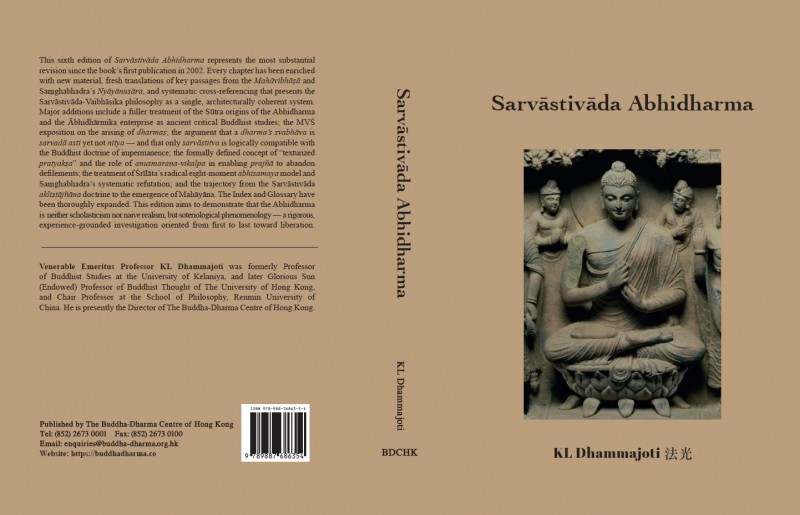
Sarvāstivāda Abhidharma. (6th Edition)
Author: Venerable Professor K L Dhammajoti
Publisher: The Buddha-Dharma Centre of Hong Kong
(Hong Kong, 2026). pp. 760++ ISBN: 978-988-76863-5-4
Published with the sponsorship of Glorious Sun Charity Group, Hong Kong
The fifth edition of Sarvāstivāda Abhidharma has been out of print for several years. This new edition makes some revision to a few places in previous edition. This scholarly work presents a comprehensive survey of all the important doctrines of Sarvāstivāda Abhidharma tradition. It is well-documented and utilizes such important references as *Abhidharma-mahāvibhāṣā, Abhidharmakośabhāṣya and *Abhidharma-nyāyānusāra.
CONTENTS
Preface
Abbreviations
Chapter 1 Abhidharma – Its Origin, Meaning and Function
1.1. Origin of the Abhidharma
1.2. Definitions of Abhidharma
1.3. The soteriological function of the Abhidharma
1.4. The Abhidharma enterprise as soteriological phenomenology
Chapter 2 The Ābhidhārmika – Standpoint, Scope and Methodology
2.1. Fundamental standpoint of the Ābhidharmikas
2.2. Arguments for Abhidharma being buddha-vacana
2.3. Scope of study of the Ābhidharmikas
2.4. Ābhidharmika methodology for dharma-pravicaya
2.5. Classification of dharmas
Chapter 3 The Sarvāstivāda School and Its Notion of the Real
3.1. History of the Sarvāstivāda
3.2. Sarvāstivāda vs. Vibhajyavāda
3.3. Proof of the thesis of sarvāstitva in VKŚ, MVŚ and AKBh
3.4. Sautrāntika critique of the epistemological argument
3.5. Notion of the real/existent
3.6. The various components of the Sarvāstivāda school
Chapter 4 The Abhidharma Treatises of the Sarvāstivāda
4.1. Seven canonical treatises
4.1.1. Treatises of the earliest period
4.1.2. Later, more developed texts
4.2. Development of the Sarvāstivāda manuals
4.2.1. Abhidharma-mahāvibhāṣā (MVŚ)
4.2.2. Development of the more concise manuals
Chapter 5 Sarvāstitva and Temporality
5.1. The big debate
5.2. Time and temporality
5.3. The four main theories of the Sarvāstivāda
5.4. Comments on the four theories and Frauwallner’s observations
5.5. The Vaibhāṣika theory of kāritra
5.6. Saṃghabhadra’s theory — an innovation?
5.7. Bhāva, svabhāva and the dharma
5.8. Concluding remarks: temporality and the Ābhidhārmika enterprise
Chapter 6 Theory of Causality I: The Six Causes
6.1. The 6 hetus, 4 pratyayas and 5 phalas — their correlation
6.2. Special importance of the doctrine of causality for the Sarvāstivāda
6.3. Definitions of the six causes
6.4. Saṃghabhadra’s defense of simultaneous causation
6.5. Explanations in the Yogācāra system
6.6. Summary of the notion of the co-existent cause given in the various sources
6.7. Doctrinal importance of the co-existent cause for the Sarvāstivāda
6.8. Conclusion
Chapter 7 Theory of Causality II: The Four Conditions and the Five Fruits
7.1. Doctrine of the four conditions (pratyaya)
7.2. Differences between a cause and a condition
7.3. Five fruits (phala)
7.4. The ‘grasping’ and ‘giving’ of a fruit
Chapter 8 The Category of Matter (rūpa)
8.1. General nature and definition of rūpa
8.2. Primary and derived matter
8.3. ‘Atomic’ theory
Chapter 9 The Categories of Thought and Thought-concomitants (citta-caitta)
9.1. Definitions of citta, manas and vijñāna
9.2. Thought-concomitants (caitta/caitasika)
9.3. Development of the theory of caitasika
9.4. Sarvāstivāda doctrine of conjunction (saṃprayoga)
9.5. Dārṣṭāntika and Sautrāntika Doctrine of successive arising
9.6. Difference in functionality between citta and caittas
9.7. Difference between the first five and the sixth consciousnesses
9.8. Original nature of thought
Chapter 10 Theories of Knowledge
10.1. Sarvāstivāda realism: From epistemology to ontology
10.2. Various modes of operation of prajñā
10.3. Reflexive knowledge and omniscience (sarvajñā)
10.4. Prajñā of the Buddha and the two yānas
10.5. Instrument of perception
10.6. Important Sarvāstivāda thought-concomitants involved in discriminative cognition
10.8 Ontological status of the objects of knowledge
10.8. Direct perception, ākāra, sākāra-vijñānavāda, nirākāra-jñānavāda and the Sarvāstivāda
Chapter 11 The Category of the Conditionings Disjoined from Thought (citta-viprayukta-saṃskāra)
11.1. Doctrinal evolution of the category
11.2. Definition of conditionings disjoined from thought in later texts
11.3. Classic list in AKBh
Chapter 12 Defilements
12.1. The goal of spiritual praxis and the abandonment of defilement
12.2. Kleśa and anuśaya as the generic terms for defilement
12.3. Other doctrinal terms denoting defilements
12.4. Defilements as the root of existence
12.5. Ābhidharmika investigation of defilements
12.6. Classification of defilements
12.7. Relationship between defilements and the mind
12.8. Operation of the defilements
12.9. Abandonment of defilements
12.10. Traces (vāsanā) of the defilements and distinction between the wisdom of a Buddha and of an Arhat
Chapter 13 The Doctrine of Karma
13.1. Meaning and general nature of karma
13.2. Classification of karma
13.3. Informative (vijñapti) and non-informative (avijñapti) karma
13.4. Definition and intrinsic nature of informative and non-informative karma
13.5. Non-information as restraint, non-restraint and neither-restraint-nor-non-restraint
13.6. Paths of karma (karma-patha)
13.7. Rationale for the doctrine of non-informative karma
13.8. Role of the non-informative in the process of karmic retribution
Chapter 14 Karma and the Nature of its Retribution
14.1. Karmic retribution as a Middle Way doctrine
14.2. Six causes affecting the gravity of a karma
14.3. Determinate and indeterminate karma
14.4. A karma that has been done, and one that has been accumulated
14.5. Projecting and completing karmas
14.6. Karma in terms of pratītya-samutpāda
14.7. Past karma of the arhats and the Buddha
14.8. Man’s karma and his environment, and collective karma
Chapter 15 The Path of Spiritual Progress
15.1. Doctrine of gradual enlightenment
15.2. Preliminaries for the preparatory stage
15.3. Different stages of the path
15.4. Direct realization (abhisamaya), path of vision (darśana-mārga) and stream entry (srotaāpatti)
15.5. Non-retrogressibility of stream-entry
15.6. Path of cultivation (bhāvanā-mārga)
15.7. Attainment of the four fruits of the spiritual life
15.8. Out-of-sequence attainments
15.9. Retrogressibility of an arhat
Chapter 16 The Unconditioned (asaṃskṛta) Dharmas
16.1. Three unconditioned dharmas of the Sarvāstivāda
16.2. Cessation through deliberation
16.3. Cessation independent of deliberation
16.4. Space
Select Bibliography
Glossary
Index
For ordering these publications, please email us at publication@buddha-dharma.org.hk
International Book Orders
At present we use Paypal to settle international book orders. Customers should advise on the title of the books required, the quantity, as well as the name and address of the recipients at publication@buddha-dharma.org.hk.
Local Book Orders
Interested local readers could also purchase the hardcopy of the books at The Buddha-Dharma Centre of Hong Kong.
Our official office hour is weekdays 10:00 – 6:00pm (lunch hour: 1:00 – 2:00pm). The office is closed on weekends and public holidays.